


You have $2 million or more. So why can’t you retire?
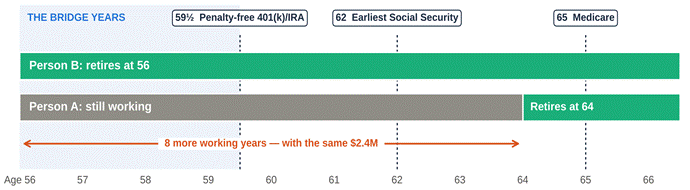
Two people walk into our San Diego office, both are 56, both have exactly $2.4 million. One can retire this year. The other has to work until 64 — and there's nothing we can do about it.
Same age, same net worth. An eight-year difference and it has nothing to do with how much they saved, how their investments performed, or how much they spend. It comes down to something almost no one checks on their balance sheet: where the money sits — and when you can reach it.
_____________
Why Your 50s are Different
Most retirement advice is written for 62-year-olds. At 56, you're on the wrong side of three doors: penalty-free retirement-account access at 59½, Social Security at 62, and Medicare at 65. You aren't funding a retirement yet — you're funding a bridge, and it has to be built from the right kind of money.
The Four Traps That Keep Millionaires Working
1. All pre-tax If $2.1M of your $2.4M sits in a 401(k), touching it before 59½ means a 10% penalty, plus income tax. Workarounds like 72(t) and the rule of 55 are rigid — a poor fit for a multi-year bridge. | 2. Concentration $1.7M in one company’s stock with a large, embedded gain. The tax bill breeds hesitation, and all too often, people ride a single position through a 40% drop just as they retire. | |
3. An illiquid balance sheet Real estate, a business, or a partnership stake, may be your best asset — but it won’t pay the $14,000 a month you need next year. | 4. Dependents still on the clock A 16-year-old means two more years of high school, then four years of university tuition. You can’t tell a college it’s a bad market year. |
The common thread: not a shortage of wealth, but a mismatch between the money you have and the money the next eight years require.
The Good News: This Is Fixable — But Only in Advance
Your 401(k) still counts enormously; it may not be accessible on your timeline. At 56 the constraint is liquidity, not wealth. Redirecting your last few working years of savings into a brokerage account instead of maxing pre-tax contributions builds the necessary bridge.
Same total savings, a completely different retirement date, and it's the highest-leverage move available in your early 50s.
Inside the Numbers: Two $2.4 Million Retirees
_____________
Same net worth, very different access
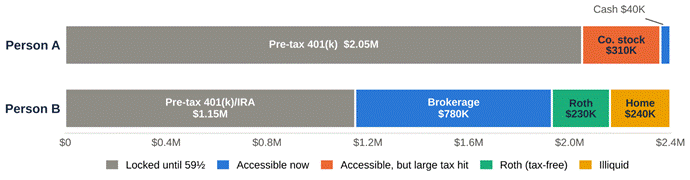
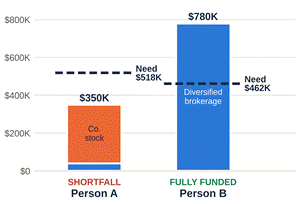
- Person A, works until 64. Holds $2.05M in a 401(k), $310K in company stock and $40K in cash; spends $148K a year with a 15-year-old at home. Reaching 59½ takes about $520K, but only $350K sits outside the 401(k) — almost all of it in stock that triggers a capital gain when sold. Every path means a penalty, a big tax bill, or both. Person A isn't poor. Person A is illiquid.
- Person B, retires at 56. Same $2.4M, structured differently: $1.15M pre-tax, $780K in a diversified brokerage account, $230K Roth and a paid-off home. Living off the brokerage account keeps taxable income low — so B can convert ~$120K a year from the pre-tax account to a Roth in the 12–22% brackets and qualify for ACA health subsidies until Medicare. No penalties. No forced sales.
Can they fund the bridge to 59½?
The three types who can retire in their 50s
_____________
In 20+ years of retirement planning, the clients who retire early fit at least one of these profiles. The strongest fit two.
Type 1: The Bridge Builder
Enough money outside retirement accounts — roughly $450–500K for a couple spending $150K a year — to cover spending until 59½. Bonus: low taxable income opens the cheapest Roth-conversion window of their lives.
Type 2: The Income-Floor Retiree
A pension, rental income or royalty covers the essentials. If $90K of a $150K budget arrives regardless of markets, the investment portfolio only needs to supply $60K. Part-time consulting works the same way.
Type 3: The Structurally Flexible
Paid-off home, no dependents, real discretionary spending. They can absorb a 20% cut through two bad market years — the direct antidote to sequence risk.
Quick Self-Check: Which Type Are You?
☐ At least 3–4 years of spending sits outside my retirement accounts.
☐ A pension, rental or other steady income covers my essentials.
☐ My home is paid off and no one depends on my paycheck.
☐ I could cut spending 20% for two years without hardship.
Checked none? Your timeline may be longer than your balance suggests. Checked one or more? You may be closer to retirement than you think.
Sound Management for your Secure Future
_____________
Pacific Wealth Management is a fee-based, fiduciary firm offering comprehensive Retirement Planning expertise.
Book Your Complimentary Retirement Structure Review
In one conversation, we'll show you:
- Which of your dollars you can actually reach before 59½
- What your bridge to Medicare and Social Security needs to look like
- Whether you're closer to Person B than you think
As a fiduciary, we are legally required to act in your best interest. There's no cost and no obligation.
Pacific Wealth Management, LLC
11512 El Camino Real, Suite 350
San Diego, CA 92130
858.509.9797
Person A and Person B are hypothetical illustrations for educational purposes, not actual clients; individual results will vary. This material is not tax or legal advice.